Apart from Google, you now need SEO to show up in Al overviews too. So if you run a
web
development agency and someone asks Al, “What are the best web development
agencies?”, you want SEO to help Al recognize yours as a top choice.
If you came here thinking SEO is dead for small businesses, stick around. I’ll break down
what’s possible with modern SEO, and when you shouldn’t waste your time on it.
Table of Contents
ToggleWhy SEO Matters for Small Businesses
Launching a new business is the best dopamine hit until you realize no one finds you
online. That’s when SEO makes your business visible, but a lot is going on behind that
visibility. Let’s see how SEO makes a difference for your business.
The changing buyer journey
Brand websites play a key role in consumer buyer decisions. So if you aren’t there in the
search results, your target audience will not consider your brand for buying.
Local mobile searches have also increased by 500% over the past 2 years. Therefore, if you
run a local business, optimize your Google My Business profile so your customers can find
you when they search ‘X near me’.
Competitive edge against bigger brands
Carefully crafted SEO strategies let you compete with the big brands in your niche. With Al,
you need to have branding and content assets so strong that Al cites your website when
users look for relevant information.
Optimize your website to appear in Al-generated overviews and establish topical authority
to improve your online trustworthiness.
Success depends on your business
The performance of any marketing channel depends on where your target audience
spends their time. If your target customers don’t use search engines to look for what you
offer, then SEO won’t be your best bet for visibility or conversions.
For example, if you’re selling an impulse-buy product like a cute pen holder, SEO wouldn’t
do much for you. Instead, focus on gaining eyes on Instagram or TikTok.
SEO as a low-cost, long-term marketing strategy
Unlike ads, which can deliver quick results but come with an ongoing cost, SEO takes a little
longer to build authority. But once if done right, your content sticks in search results, so
whenever someone searches for a solution to a problem you can help with, your business
shows up.
And 27% of marketers say organic search is the top lead generator. While SEO might take a
bit longer to kick in, the payoff is worth the wait.
What makes local SEO a must- have for small businesses?
In local SEO, instead of competing for broad global keywords, you’re targeting local intent.
This makes your competition pool smaller and helps you rank for keywords like “dentists in
New Jersey” or “painters in Melbourne.”
How to get started with local SEO?
A Google Business Profile is your business’s official listing on Google. It includes information
such as your business name, address, phone number, website, hours of operation, and
customer reviews.
When you set up your Google Business Profile, your business appears on Google Maps,
which increases your local visibility and trust.
Who needs local SEO the most?
If you have a brick-and-mortar business, such as a salon, pet grooming studio, clinic, or
any other service that requires in-person interactions, you should optimize for local SEO.
If you don’t have a physical location but your services are targeted at a local audience,
such as online coaching for people in your region, then local SEO should also be a focus.
How long before SEO pays off?
The time SEO takes to show significant results depends on your niche, market saturation,
competition, region, and your SEO expertise. But let’s look at a typical timeline of results.
Typical timeline for results
Typically, you should start seeing movement in your metrics in 3-6 months. With
consistency and a balance in both on-page and off-page SEO, you can expect to see
good rankings, organic traffic increase, and conversions from SEO.
Factors that affect SEO speed
Some businesses see faster results than others. This is because SEO success depends on a
variety of factors.
- Industry competition: Ranking for “best CRM software” is way harder than ranking for
“vegan bakery in Boise.” - Website quality: Your website needs to be optimized to see SEO results. If it’s slow,
unstructured, and clunky, you should get that fixed first. - Domain age and authority: New websites are more challenging to rank due to their
lower authority, domain age, and unestablished brand. - Off-page SEO: Bots think your website is high-quality if other high-quality websites link
to your website. Building backlinks and investing in PR can speed up your SEO success.
How SEO compares to other marketing channels
While SEO is my business, I’m glad to have the ethics to tell you that this isn’t the only
channel you should consider.
You should have a website ready when you decide to put efforts into SEO; whether you
need to optimize it right now depends on your specific needs.
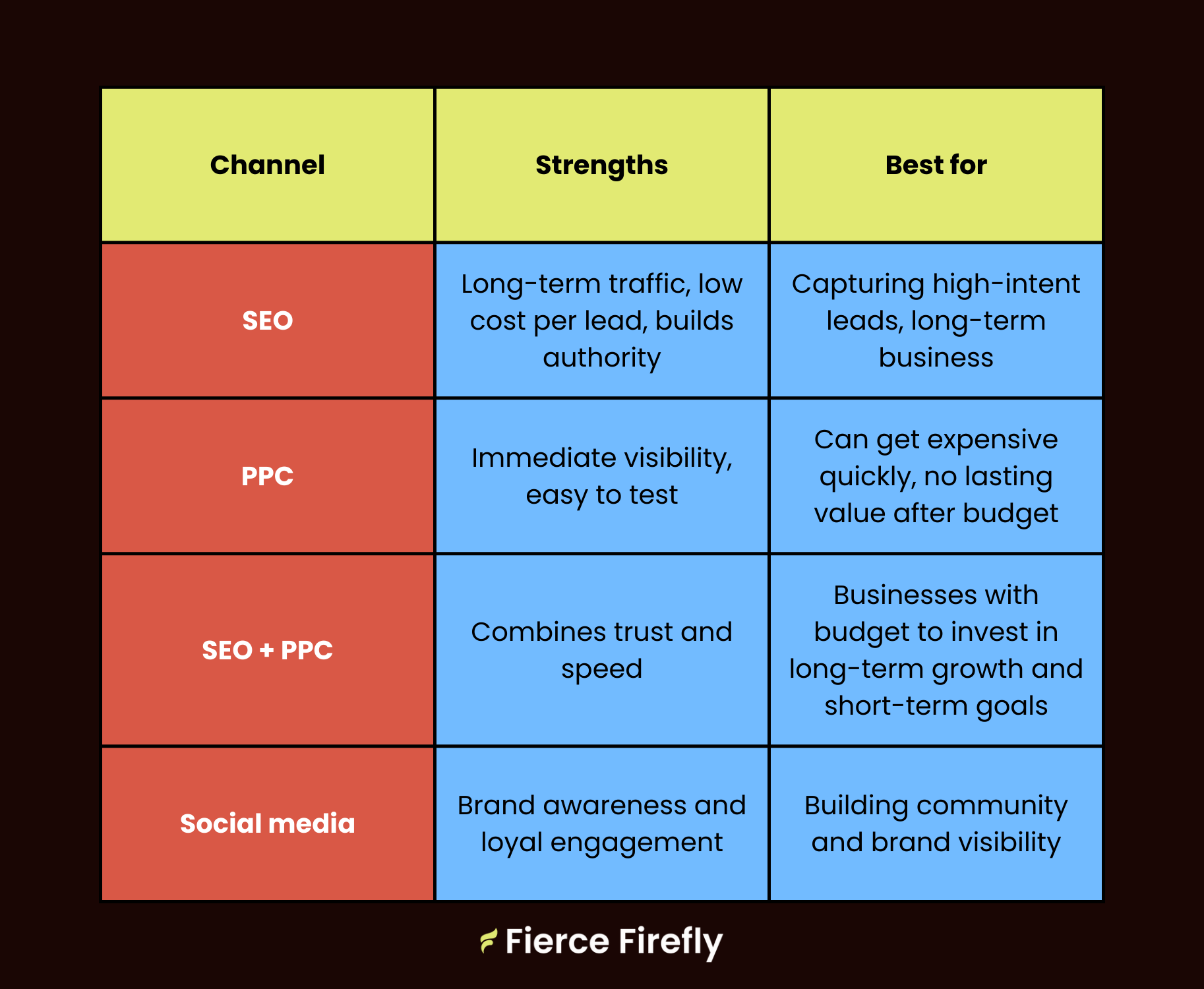
If you’re not ready to invest in PPC, focus on SEO and social media to gradually build
visibility and trust. But if you have the budget for paid testing and want sustainable growth,
combine SEO with PPC to get the best of both worlds.
Costs of doing SEO and what impacts ROI
DIY SEO vs. hiring an expert
The key trade-off is time investment versus cost when deciding between DIY SEO and
hiring an expert. DIY SEO can save money upfront, but it requires a significant amount of
time and effort to implement effective strategies.
Hiring an expert or agency involves higher costs but brings professional expertise, faster
results, and access to advanced tools.
Off-page SEO, such as link building, is crucial for improving your site’s authority and
rankings, but is often overlooked or poorly executed by some professionals. This can be
risky and harm your rankings, so choose providers with proven skills in this area.
Tools and platforms you might need for DIY SEO
- Google Search Console: Tracks website performance in Google search, identifies
indexing issues, and monitors keyword rankings. - Google Analytics: Provides insights into website traffic, user behavior, and conversions.
- Keyword Research Tools: Platforms like Ahrefs, SEMrush, or their alternatives help
identify valuable keywords, analyze competitors, and track rankings. - Other SEO tools may include site audit tools like SiteBulb and content writing and
optimization software like SurferSEO or Copy.ai to support both on-page and off-page
SEO efforts. The need for these tools depends on your needs.
For example, if you don’t have writing capabilities and aren’t looking to hire new writers,
you can use Copy.ai or other Al writing tools. But these tools come with their challenges,
such as producing generic, low-quality output, and Google assigning a low rate to Al-
generated content.
How to tell if SEO is worth it for your business
If you’re still unsure if SEO is worth it for your small business, ask yourself the following
questions to get a clear idea:
- Can you afford to wait 6 months to see conversions? Since SEO isn’t a quick fix, choose
it if you can wait for meaningful results, such as higher rankings, increased traffic, and
more leads. - Do you’ve the time and resources to stay consistent? SEO success requires consistency
in high-quality content and ethical off-page efforts. If you can’t do this, SEO shouldn’t be
your marketing channel. - Are people searching for your product? SEO is only valuable if people are searching for
your product. For example, if you’re selling garden gnomes that improve creative
thinking, your first step should be to raise awareness on social media before people
start searching for this.
To gain a better understanding of how SEO can benefit your business, contact us today,
and we’ll get back to you with a tailored SEO plan.
Final verdict: Is SEO worth it for small businesses?
SEO is worth it for small businesses looking for long-term growth and brand building. While
it takes a little longer than six months, the efforts you put in today will still drive leads a few
years from now.
Plus, with the rise of Al search features, SEO helps you rank on Google and makes it easier
for Al to recommend your business when people look for the best options.
However, you need to ensure that your SEO service provider uses ethical practices so you
only get good outcomes.